
Unlock the Power of Residential EV Chargers: A Comprehensive Guide to Making the Right Choice for Your Home
If you’ve bought an electric vehicle—or you’re about to—you’ve probably already realized something important: relying on public charging gets old fast (and expensive!). Waiting, planning your day around chargers, and hoping one is available isn’t exactly convenient. That’s why most EV owners end up asking the same question:
“How much does it really cost to install a residential EV charger, and how do I avoid overpaying?”
As an electrician who installs EV chargers for homeowners every week, I can tell you this: the price range is wide, and the details matter. The good news is that with a little planning, you can get a solid setup that’s safe, code-compliant, and doesn’t blow your budget.
Let’s break it all down in plain English.
Understanding Your Charging Needs:
Tailoring Your Charger to Your Lifestyle
Before talking dollars, you need to know what kind of charging you actually need. Not every homeowner needs the fastest or most expensive option.
Start with a few basic questions:
How many miles do you drive per day?
Do you charge overnight or during the day?
Is this your only EV, or will you add another one later?
If you drive 30–40 miles a day and charge overnight, your needs are very different from someone commuting 100 miles daily.
Types of Residential EV Chargers
Level 1 Chargers (Basic, Slow, but Simple)
Level 1 chargers use a standard 120V outlet—basically the same outlet your garage already has.
What to know:
Adds about 3–5 miles of range per hour
No special installation if an outlet is already available
Very slow for most modern EVs
Average cost:
Charger: often included with the vehicle or $300–$600
Installation: $0–$300 if no electrical upgrades are needed, but most of the time it is recommended to have a dedicated circuit for this outlet as the charger will draw around 1,300 watts and most residential outlets fall between 1800-2400 watts but are usually shared with other outlets. If you need a dedicated circuit pricing will depend on distance from panel but often $250-650.
Level 1 works if you barely drive or have a plug-in hybrid. For most full EV owners, though, it quickly becomes frustrating.
Level 2 Chargers (The Sweet Spot for Homeowners)
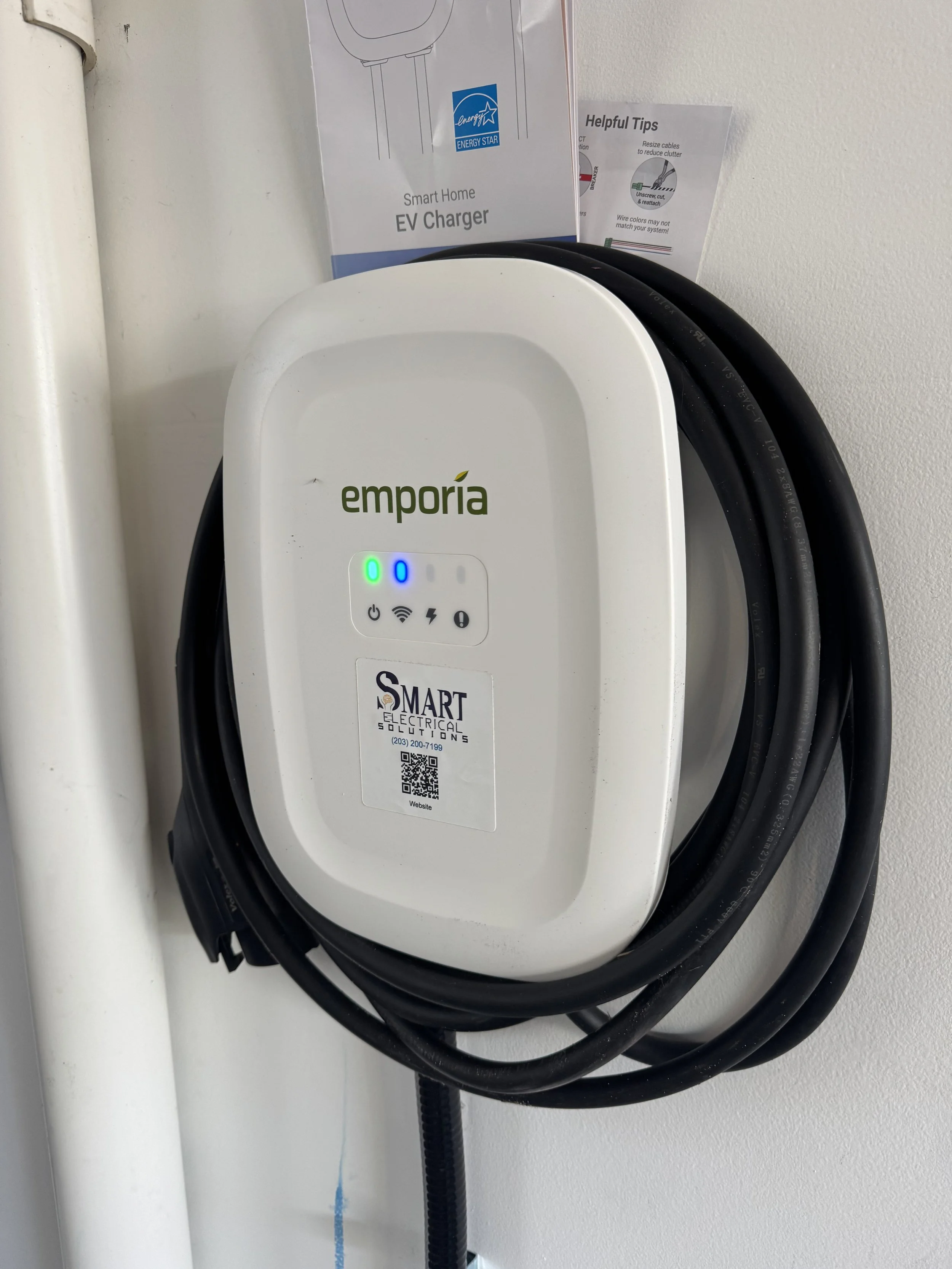
Level 2 chargers run on 240V power, similar to a dryer or range outlet. This is what most homeowners choose—and for good reason. Most level 2 chargers will be 48A rated with a few being up to 80A, but few vehicles are compatible with 80A, and most homes will not be able to handle it without a load management device, and because it needs copper wiring rated at 90C the cost can be very high.
What to know:
Adds on average 25–44 miles of range per hour (this speed is based on amperage and vehicle battery size)
Fully charges most EVs overnight even large vehicles.
Best balance of speed, cost, and convenience
Average cost:
Charger: $400–$1,200
Installation: $800–$2,500+, depending on your home (some homes could need a panel upgrade, load management device, or have accessibility issues that increase cost)
From a professional standpoint, Level 2 is the best long-term investment for most homeowners.
Cost Factors to Consider:
Breaking Down the Costs
Now, let's talk money. While it's exciting to invest in an EV charger, you want to ensure you're getting the best bang for your buck. We'll break down the initial purchase price, installation costs, and potential additional expenses like cables and permits.
The Charger Itself
Most reputable Level 2 chargers land between $500 and $900. Smart chargers (Wi-Fi, scheduling, energy tracking) cost a bit more, but they’re worth it for many homeowners.
You don’t need the most expensive unit—just one that’s:
UL-listed
Compatible with your EV
Supported by a known manufacturer
A note on compatibility. Most chargers will either have an option for NACS or J1772. The J1772 was originally adapted by every manufacture and NACS was only Teslas, but since 2025 more and more manufactures are now switching to the NACS. I would buy a charger that matches your current car and you can always get an adapter. A few brands are coming out with universal chargers that have both options such as the Tesla Universal charger.
Installation Costs (Where Prices Vary the Most)
This is where homeowners get surprised. Even when the electrician has standard pricing, each home is unique and can have additional costs that are not included in the standard pricing. Some people have the panel in the same garage where the charger will be installed, others have the panel 150 feet on the other side of a finished basement or a detached garage which would require trenching. All of those will affect your pricing.
Typical installation costs include:
Running a new 240V circuit
Installing a breaker
Mounting the charger
Permits and inspections
Average installation ranges:
Simple install near panel: $800–$1,200
Longer wire run or attic work: $1,200–$2,400
Possible add-on costs:
Load management devices: After a load calculation if the panel will go above 80% capacity we are required to come up with solutions to keep the load below that. Sometimes we can slow down the charger, and in many cases we need a service upgrade but for a few years now a load/power management device can be installed to keep panel below the set parameters. These can be found as a bundle package with certain chargers but often are a separate purchase between $350-1500 depending on requirements.
Panel upgrade required: $2,500–$5,000+ If your electrical panel is older or already full, upgrading it is often unavoidable if we cannot use the load management meter—and it’s one of the biggest cost drivers. Many homes here in Connecticut have panels that are over 40 years old, and usually most panels should be replaced around 20 years with 30 being max. These are from brands like Federal Pacific, Pushamatic, Bryant, Westinghouse which are all outdated and discontinued so we often won’t do work without either upgrading or signed paperwork from customer that they understand the dangers.
Service upgrade: Not that common anymore since we have load management solutions, but many old homes might have only 60-100 amps and some the meter is just in very bad shape and cannot handle the load. Upgrading to 200 amps is the most common for houses under 5,000sq.ft and can be overhead or underground which would require a trench. Some homes might need to 400A which is very costly. The 200A upgrade averages $4,500-$8,500+ with underground often costing around $10,000. For large homes needing 400A upgrade it can cost $10,000-20,000 depending on many factors such as trenching, power company fees and so on.
Permits and Inspections
Most cities require a permit for EV charger installation. This isn’t a bad thing—it protects you and your home.
Typical permit costs:
$75–$450 depending on town fees, plus in some towns when placing the charger outside you need a separate zoning permit which has other fees, and then the electrician usually charges for their time to file for the permit and meeting inspector on the inspection day unless it is rolled into their install costs.
A licensed electrician will handle this for you.
Government Incentives and Rebates
Who doesn't love a good deal? Turns out, the government is pretty keen on promoting green living too. Don’t Skip This Step — It Can Save You Thousands
There are often federal, state, utility, and local rebates available for residential EV chargers.
Common incentives include:
Federal tax credit: Up to 30% of total cost (charger + installation), capped at $1,000
Utility rebates: $300–$1,000 in many areas
Local clean energy programs
These incentives change frequently, but they can significantly reduce your out-of-pocket cost.
Pro tip: Always install with permits and licensed electricians—most rebates require proof.
Town such as Westport, Darien, New Canaan, Stamford, Cheshire and Danbury are all under Eversource which is responsible for most of the state, and they are offering up to $1000 in rebates for charger and installation. United Illuminating takes care of towns such as Fairfield, Easton, Trumbull, Monroe, Milford, New Haven, and Woodbridge and they are offering $500 for the charger and another $500 for wiring if it meets certain categories.
2026 update: Last year the Federal government removed incentives and as a result the power companies here in our state of Connecticut ended the incentives at the end of 2025, but the state is planning on giving some new form of incentives.
Negotiating the Best Deal:
How to Get the Best Deal (Without Cutting Corners)
Compare Apples to Apples
When comparing quotes, make sure each includes:
Charger model
Electrical upgrades (if needed)
Permits and inspections
Warranty on labor
A cheaper quote isn’t cheaper if it skips permits or uses undersized wiring.
Ask About Charger + Installation Packages
Many electricians (myself included) offer bundled pricing when supplying both the charger and installation.
Benefits:
Better pricing
One point of contact
No compatibility issues
Cleaner warranty coverage
DIY vs. Professional Installation:
Now, let's talk installation. DIY might be your thing, but when it comes to electrical work, safety is paramount. We'll weigh the pros and cons of DIY installation, emphasizing the importance of compliance with electrical codes.
Why DIY Is Usually a Bad Idea
EV chargers draw continuous high amperage, which puts stress on wiring and breakers. Improper installs are a real fire risk.
DIY installation can:
Void charger warranties
Fail inspections
Cause insurance issues
Create long-term safety hazards
From experience: EV chargers are not the place to experiment.
Before any quotes we run calculations on the panel to figure out total load once charger is added which can influence whether load shedding devices are needed, panel upgrades and etc. We calculate for voltage drop which is based on distance from panel to charger and may require upsizing cables. We look into the type of charger and the required amperage with most requiring specific cables with higher celsius ratings to make sure everything functions safety as chargers will be pulling more power than anything else in your home for extended periods of time so proper install is very important. Wiring type and size matters, panel conditions and in some case requiring upgrades or load management systems are needed.
Why Professional Installation Pays Off
A licensed electrician ensures:
Proper load calculations
Code compliance
Safe breaker sizing
Clean, future-proof installation
It also protects your home’s resale value—buyers and inspectors love documented, permitted work.
Long-Term Costs and Maintenance
Operating Costs
Charging at home is still far cheaper than gas.
Typical home charging cost:
$8–$15 for a full charge
Depends on local electric rates
Smart chargers can schedule charging during off-peak hours, saving even more.
Maintenance Expectations
Good news: EV chargers require very little maintenance.
Occasionally:
Check connections
Inspect the cable
Keep the unit clean and dry
A quality charger installed correctly should last 10+ years.
Final Thoughts
Installing a residential EV charger doesn’t have to be complicated or overpriced. When done right, it’s one of the best upgrades you can make to your home—convenient, cost-effective, and future-ready.
The key is understanding:
What level of charging you need
What drives installation cost
Where to save and where not to cut corners
The prices here are the average that we have seen in the market from other licensed and insured electrical contractors who are also certified to install EV chargers. You might be able to find cheaper who isn’t certified but just be careful, just like a doctor might have been thought a little of everything about the human body they specialize for a reason. Same with us, although our license and training covers everything from residential to industrial, pools to solar panels, there is a reason most great companies are specialized in few areas as we can really understand and be up to date on the constant changing guidelines for EV charger installations.
If you’re planning an EV charger install and want it done safely, cleanly, and correctly the first time, working with an electrician who does EV chargers regularly makes all the difference.
Need personalized assistance? Reach out, and let's navigate the world of residential EV chargers together. We have installed over 2000 Level 2 chargers in the state of Connecticut and although we cover mostly Fairfield county and New Haven county, due to our expertise we get calls from all over Connecticut and even out of state, and have done installation in the lower portion of Litchfield county in towns such as Washington, Roxbury, and Salisbury. So wherever you are in the state of CT feel free to contact us anytime!
Your electric adventure awaits!
www.smartelectricalct.com
203-200-7199